
السلام عليكم ورحمة الله وبركاته
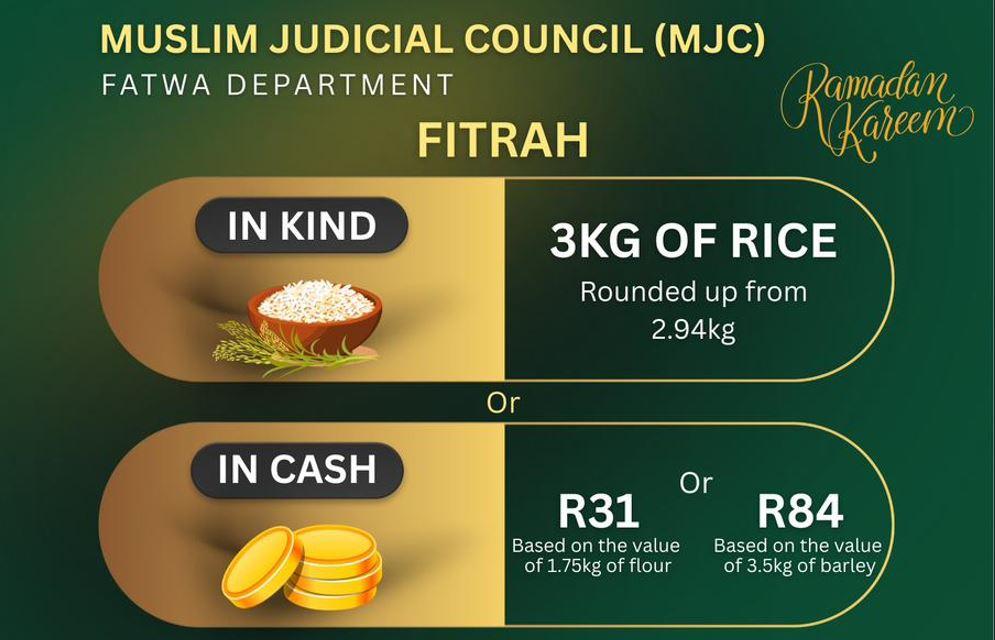
1. The Ḥanafī School is the only school that permits the payment of Fidyah and Fiṭrah in cash. Historically, Cape Shafi’ī Muslims have adopted the Ḥanafī School in this regard. The MJC encourages our communities to make cash payments, as it provides more meaningful benefits to the recipients.
2. When adopting a different madhhab, it is essential to avoid cumulative inconsistencies or talfīq. This implies refraining from blending two schools in a manner that renders the end result invalid according to both. Hence, when choosing to pay Fiṭrah in cash, it is imperative to adhere to the guidelines of the Ḥanafī School to ensure the validity of one’s payment.
3. We shifted away from using the cash value of one ṣā’ of rice for this specific reason. The Ḥanafī School does not permit the calculation of the cash value of Fiṭrah or Fidyah based on rice. According to them, the cash value should be determined from the manṣūṣ ‘alayh (textual stipulated commodities) categories, which include a half ṣā’ of wheat kernels or flour, or one full ṣā’ of barley, dates, or raisins.
4. Paying Fiṭrah in cash based on the value of rice is invalid in both the Shafi’ī and Ḥanafī Schools. In the Shafi’ī School, it is not permitted to make payment in cash; in the Ḥanafī School, the cash value cannot be derived from rice, rendering it invalid.
5. The minimum cash value for a half ṣā’ of flour is R31, while the minimum cash value for one full ṣā’ of barley is R84. The MJC could not provide one figure, as it posed challenges on two fronts.
5.1 Releasing only the higher amount would not have been faithful to the community in conveying that the minimum obligatory Fiṭrah is R31. In doing so, an additional R53 obligation would have been imposed on each payer of Fiṭrah.
5.2 Releasing only the lower amount would have hindered Zakāh organizations from achieving their Fiṭrah target for Ramaḍān, resulting in the hardship of those in need. For this reason, we provided two totals: a minimum of R31 and a preferred total of R84.
6. For the reasons mentioned earlier, our community will note that the Fidyah has been set at the same amount as the minimum Fiṭrah – R31. In the Ḥanafī School, the value of both Fiṭrah and Fidyah is the same, unlike the Shafi’ī School, which sets the price of Fidyah at a quarter of the price of Fiṭrah.
7. Our elderly, who may find it challenging to pay the higher Fidyah amount compared to previous years, should consider the following:
7.1 Fidyah is not obligatory for those who do not have the financial means to pay.
7.2 They may choose to pay in kind, 750 grams of rice for each day.
8. Another important clarification pertains to pregnant and breastfeeding women. Pregnant and breastfeeding females, who were unable to observe fast due to concerns for their children rather than themselves, should pay Fidyah for each day according to the Shafi’ī School. However, in the Ḥanafī School, there is no Fidyah payment required for pregnant and breastfeeding women. Therefore, paying in cash would not be an option for these women, and they should only fulfill their Fidyah obligation by paying in kind.
9. When paying Fidyah in kind according to the Shafi’ī School, making a once-off payment at the beginning of the month is not allowed. Instead, one must pay the Fidyah for each day after Maghrib sets in. Alternatively, one may also make a once-off payment at the end of Ramaḍān.
والله تعالى أعلم
And Allah knows best